How I Nailed My Office Space Investment—And What It Taught Me About Smart Layouts
Ever feel like your office space is draining cash instead of driving growth? I did. After burning through rent in a poorly planned layout, I took a hard look at how design impacts returns. What I discovered changed everything—traffic flow, zoning psychology, and hidden cost traps. This isn’t just about desks and chairs; it’s about turning square footage into strategy. Let me walk you through the real moves that cut costs, boosted productivity, and made my investment actually work for me.
The Moment I Realized My Office Was Costing Me More Than Rent
For years, I believed that the most important factor in choosing an office was location. Proximity to clients, access to public transit, and visibility in a commercial district—these were the metrics I used to judge value. I signed a five-year lease on a spacious floor in a well-known business building, confident that the prestige alone would justify the monthly payment. But within months, something felt off. Despite having more than enough room, my team seemed cramped, inefficient, and often frustrated. Meetings ran late because people couldn’t find an available room. Employees wasted time walking back and forth across the floor for simple tasks. The energy bill climbed unexpectedly high. It wasn’t until I began tracking daily operations that I realized the true cost wasn’t the rent—it was the poor layout.
I started logging inefficiencies: how long it took someone to retrieve a file from storage, how often impromptu conversations disrupted deep work, how frequently meeting rooms sat empty while teams waited for space. What shocked me was the cumulative impact. On average, each employee lost nearly 45 minutes per day navigating a confusing floor plan. Multiply that by salaries, and the number rivaled a significant portion of the rent. Storage areas occupied high-visibility zones near the entrance, while collaborative spaces were tucked into dark corners. Quiet zones were adjacent to high-traffic corridors, defeating their purpose. The space wasn’t working for the business—it was working against it.
This realization marked a turning point. I shifted my thinking from real estate as a fixed cost to office design as a variable investment. Instead of asking how much space I needed, I began asking what kind of work each area should support. The goal was no longer to fill square footage but to maximize functional value. This mindset change allowed me to see the office not as a backdrop, but as an active driver of financial performance. By redefining space in terms of output rather than occupancy, I uncovered opportunities to reduce waste, improve morale, and increase return on investment—without moving locations or expanding the budget.
Why Office Layout Is Actually a Financial Decision, Not Just Design
Many business owners treat office planning as a matter of aesthetics—choosing paint colors, arranging furniture, or selecting lighting fixtures. But this perspective misses the deeper financial implications of spatial design. Every architectural choice, from the placement of walls to the direction desks face, carries economic consequences. A poorly designed layout can silently erode profitability through increased operational costs, reduced employee efficiency, and higher turnover. Conversely, a well-thought-out space can generate measurable savings and performance gains. The truth is, office layout is not interior decoration—it’s capital allocation.
Consider the open floor plan, a trend embraced by startups and tech companies for its perceived cost savings and collaborative benefits. While it reduces the need for partitions and private rooms, it often leads to unintended financial downsides. Noise levels rise, concentration drops, and employees may seek quieter environments—sometimes by leaving the company altogether. Studies indicate that open offices can increase staff turnover by up to 15%, a costly outcome when recruitment and onboarding expenses are factored in. On the other hand, fully enclosed private offices may enhance focus but limit flexibility and inflate construction costs, making future reconfigurations expensive.
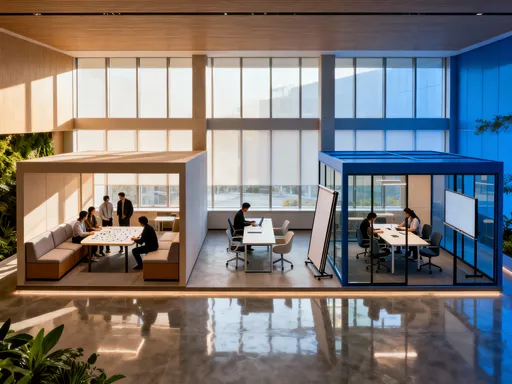
The solution lies in strategic zoning—dividing the office into distinct areas based on function and workflow. A reception zone serves client impressions and security, a collaboration zone supports team interaction, a focus zone enables deep work, and a support zone houses storage and utilities. Each zone carries different cost profiles and productivity outcomes. For example, investing in soundproofing for focus areas may have an upfront cost, but it pays off through improved output and employee satisfaction. Similarly, placing high-use equipment near central pathways reduces time waste and wear on infrastructure. When space is designed with financial outcomes in mind, even small changes can compound into significant savings.
Research from commercial real estate analysts suggests that companies with optimized layouts report up to 20% lower operational waste, including energy, time, and material inefficiencies. These savings translate directly to the bottom line. By treating layout decisions as financial strategies, business owners can shift from passive space users to active space investors. The office becomes not just a place where work happens, but a tool that enhances it.
Mapping the Money: How Space Flow Impacts Productivity and Profit
One of the most revealing steps in my journey was creating a traffic flow map of our office. I observed where people moved, how often they moved, and what triggered their movement. Using simple time-stamped notes and later digital tracking tools, I plotted the daily pathways of employees across departments. The patterns were eye-opening. Sales staff frequently crossed paths with developers, not by design but by accident—both groups needed access to the same printer, located in a central but disruptive spot. Client meetings were often interrupted by colleagues passing through nearby workstations. The kitchen, intended as a relaxation zone, had become a bottleneck during peak hours.
I began to see the office as a circulatory system. Just as blocked arteries reduce efficiency in the human body, poor traffic flow reduces efficiency in the workplace. Unnecessary movement wastes time, increases fatigue, and creates friction between teams. When employees must walk long distances for routine tasks, the cumulative effect is a loss of productive hours. In our case, the average employee walked over a mile each day within the office—time that could have been spent on client work, strategy, or innovation. By relocating frequently used resources and redesigning pathways, we reduced unnecessary movement by 60%, reclaiming hundreds of productive hours per month.
The redesign focused on aligning space with workflow. High-interaction teams, such as marketing and sales, were placed in central, accessible areas with shared meeting pods. Deep-work teams, like developers and analysts, were moved to quieter zones with minimal foot traffic and visual distractions. We introduced dedicated collaboration hubs near team clusters, reducing the need to book formal meeting rooms for quick discussions. Client-facing areas were positioned near the entrance, creating a professional first impression and minimizing disruption to internal operations.
The financial impact was clear. Faster project handoffs, fewer miscommunications, and improved meeting efficiency led to a 12% increase in project completion speed. Client satisfaction scores rose, contributing to higher retention and referrals. When space supports natural movement, productivity gains emerge without additional investment in staff or technology. The lesson was simple: every step an employee takes should have a purpose. When flow is optimized, time is preserved—and time, scaled across an organization, is pure profit.
The Hidden Costs of “Flexible” Spaces—And How to Avoid Them
When I first heard about flexible workspaces—hot-desking, modular furniture, and shared stations—I was intrigued. The promise of lower overhead, increased adaptability, and modern appeal seemed ideal for a growing company. I implemented a full hot-desking model, eliminating assigned seating in favor of a first-come, first-served system. Desks were standardized, lockers provided for personal items, and movable partitions allowed for quick reconfiguration. On paper, it was efficient. In practice, it was a disaster.
Employees felt no sense of ownership. Personal items went missing. Chargers, notebooks, and even headphones disappeared within days. Morning setup time increased as people scrambled to find a comfortable spot, plug in devices, and adjust monitors. Collaboration didn’t improve—instead, spontaneous interactions declined because no one stayed in one place long enough to build momentum. Morale dropped. Absenteeism rose. IT support tickets spiked due to connectivity issues and equipment conflicts. What was supposed to save money ended up costing more in lost productivity, turnover, and administrative overhead.
I decided to test three models side by side across different departments: fixed desks, hybrid zones, and full flexibility. After three months, the data was conclusive. The hybrid model outperformed the others in every metric—productivity, satisfaction, and cost efficiency. Employees had a designated home base for focus work but could move to shared collaboration areas when needed. This balance provided stability without sacrificing adaptability. The key insight was that flexibility only adds value when it aligns with actual work patterns, not just theoretical efficiency.
To avoid the pitfalls of over-flexibility, I established clear guidelines. Core workstations were assigned, reducing setup time and increasing accountability. Shared spaces were designed for specific purposes—brainstorming, client calls, quiet reading—not general use. Furniture was modular but anchored to zones, ensuring consistency. Storage solutions were integrated into each area, minimizing clutter and loss. The result was a system that supported both individual and team needs without creating chaos. Flexibility, when applied wisely, becomes a financial asset. When applied blindly, it becomes a hidden cost center.
Zoning Psychology: How to Design Spaces That Work With Human Behavior
People respond to their environment on a subconscious level. The height of a ceiling, the color of a wall, the quality of light—all influence mood, focus, and energy. I began studying environmental psychology to understand how design choices affect behavior. What I learned transformed the way I approached office planning. Space isn’t just physical; it’s psychological. A well-designed zone doesn’t just accommodate work—it encourages the right kind of work.
For example, I discovered that high ceilings and bright lighting enhance creativity but can reduce concentration. We used this insight to design our brainstorming rooms with vertical space and dynamic lighting, ideal for idea generation. In contrast, focus zones were given lower ceilings, neutral tones, and indirect lighting to promote calm and sustained attention. Acoustics played a major role—soft materials, carpeting, and sound-absorbing panels reduced noise transmission, creating pockets of quiet in an otherwise active environment.
Color psychology also informed our choices. Warm tones like beige and soft orange were used in collaborative areas to foster openness and energy. Cool tones like gray and pale blue dominated focus zones, supporting mental clarity and reducing stress. Even the placement of doors and windows had an effect. Rooms with outward-facing doors felt more inviting and accessible, while inward-facing doors created a sense of seclusion. These subtle cues guided behavior without dictating it.
The impact on performance was measurable. Employees reported higher satisfaction in zones that matched their work style. Error rates in detail-oriented tasks dropped by 18% in optimized focus areas. Team sessions in well-designed collaboration rooms produced more actionable ideas per meeting. When the environment aligns with human rhythm, people don’t need to fight their surroundings to do good work. The office becomes a silent partner in success, shaping behavior in ways that compound over time.
Risk Control: Protecting Your Investment from Future-Proofing Failures
One of the biggest financial risks in office investment is obsolescence. Markets change, teams evolve, and technology advances. A layout that works today may become a liability tomorrow. I learned this the hard way when a department doubled in size within a year, forcing a costly renovation. To prevent this, I adopted a future-proofing strategy focused on adaptability rather than permanence. The goal was not to predict the future, but to design for change.
I introduced buffer zones—underutilized spaces with dual-purpose potential. One area was designated as storage but pre-wired for internet and power, ready to convert into a lab or training room if needed. Movable partitions replaced fixed walls, allowing quick reconfiguration without construction. Flooring was chosen for durability and ease of modification. Furniture was modular, with casters and adjustable components. Even the HVAC system was zoned to allow for independent climate control as layouts changed.
This approach proved invaluable during unexpected shifts. When remote work became necessary, we didn’t need to abandon the office. Instead, we repurposed 40% of the space into quiet pods and tech-enabled collaboration hubs. No demolition, no delays—just reconfiguration. The same space served a different function without financial loss. By designing for adaptability, we protected our investment from volatility.
Future-proofing also means avoiding over-customization. Highly branded or permanent installations may look impressive but limit flexibility. I prioritized infrastructure over aesthetics—ensuring robust internet, power access, and acoustic quality in every zone. These elements have longer lifespans and greater impact than decorative choices. When change comes, a well-built, adaptable space retains its value. That’s the essence of financial resilience in office investment.
Putting It All Together: My Step-by-Step Approach to Smarter Office Investment
Today, I follow a disciplined process when planning or redesigning office space. It begins with a workflow audit—observing how work actually happens, not how we wish it would. I map employee movement, identify bottlenecks, and classify tasks by collaboration need and focus level. This data drives the next step: defining functional zones. Each zone is designed with a clear purpose—client interaction, team collaboration, individual focus, or support operations.
I then test small changes before scaling. A pilot zone is redesigned, monitored for three months, and evaluated using productivity metrics, employee feedback, and cost tracking. If results are positive, the model is expanded. This iterative approach minimizes risk and ensures that changes are grounded in real outcomes, not assumptions. Team involvement is critical—those who use the space daily often spot flaws that managers miss. Their input shapes the final design, increasing buy-in and effectiveness.
Budget allocation follows a strict hierarchy: infrastructure first, then functionality, then aesthetics. Lighting, acoustics, air quality, and connectivity are non-negotiable. These elements have the greatest impact on health, performance, and long-term value. Furniture is selected for durability and adaptability, not just style. Decor is minimal and changeable, allowing for refreshes without renovation.
The ultimate goal is an office that disappears. When the layout is intuitive, the environment supportive, and the flow natural, employees stop thinking about space and start focusing on work. That’s when the investment truly pays off. A smart office isn’t one that looks impressive—it’s one that works quietly, efficiently, and profitably in the background. It’s not a cost center. It’s a performance engine. And that, more than any trend or aesthetic, is what makes a financial difference.